
AI is Rewriting Mathematics
The beginning of the beginning.

At what point are people going to accept that AI is changing absolutely everything. Some people still call LLMs stochastic parrots and what not. This is total nonsense.
AI is rewriting mathematics. Just look at this timeline for the last 2 weeks:
July 20: Levent Alpöge announces he has proven the Jacobian conjecture is false. This problem was open for 87 years and was first proposed by Keller in 1939. According the greatest living mathematician, Terrence Tao, this was not a ‘brute force’ solution and required genuine creative insight [Link].
July 22: Dmitry Rybin announces the Dinitz-Garg-Goemans conjecture is proven false [Link]. This graph theory problem was open for ~30 years. His method was to literally ask ChatGPT for a counterexample, and then insist it continue its research and find one. No special prompting or context required. Read his chat so you can understand how absurd it is [Link].
July 23: Jared Zoneraich announces Graffiti Conjectures 39 & 40 are proven [Link]. They’ve been around for 40 years. Brandt's Regular Supergraph Problem was successfully refuted. This is from West's open problems list and has been around for ~20 years.
Also on July 23, mathematician Shouqiao Wang announces he solved 6 open Erdős problems in 5 days using GPT-5.6 Sol [Link].
July 24: Prabhanjan Ananth and Amit Sahai solved the unclonable encryption problem. This was one of the bigger open questions in quantum cryptography for the last 6 years, and was solved using the assistance of GPT-5.6 Sol Ultra.
July 25: Digvijay Bokey proves the Levit–Mandrescu conjecture is false. This graph theory problem was open for ~20 years [Link].
July 26: Three groups independently solved the same major problem in quantum information theory almost simultaneously [Link]. The problem was highlighted as one of “Five Open Problems in Quantum Information Theory” in 2022 and was open for 26 years. Two groups explicitly used GPT‑5.6 Sol using basic prompts; human researchers then verified it. The third group published first but did not disclose whether they used AI.
July 28: A man named Zhengqing proves a well known probability problem that had been open for 22 years using GPT‑5.6 Pro [Link]. It proved that when several independent random amounts are added together, there is always at least a 37% chance that the total stays reasonably close to its average.
July 30: Tencent’s Hyra research agent helped solve a 57-year-old problem in combinatorics [Link]. The problem asks how the number of distinct sums from a set of numbers compares with the number of distinct differences. Mathematicians had known the maximum possible gap since 1969 but did not know whether any sets could actually reach it. Hyra helped construct examples proving that the old limit is exact [Link].
Also July 30, Dominik Peters used GPT-5.6 Sol Ultra to settle a 25-year-old question about voting [Link]. It proved that combining three people’s ranked choices into the fairest possible final ranking is a fundamentally difficult computing problem, even though there are only three voters.
July 31: Philip Arathoon announces the Maxwell conjecture is false with a counterexample found by GPT-5.6 Sol [Link]. This was open for 153 years.
August 1
OpenAI announces their next major model, Astra, solved 10 major open problems in mathematics, quantum complexity and theoretical computer science. The cost of generating proofs for all 10 of these combined was less than $2,000 at Sol API prices.
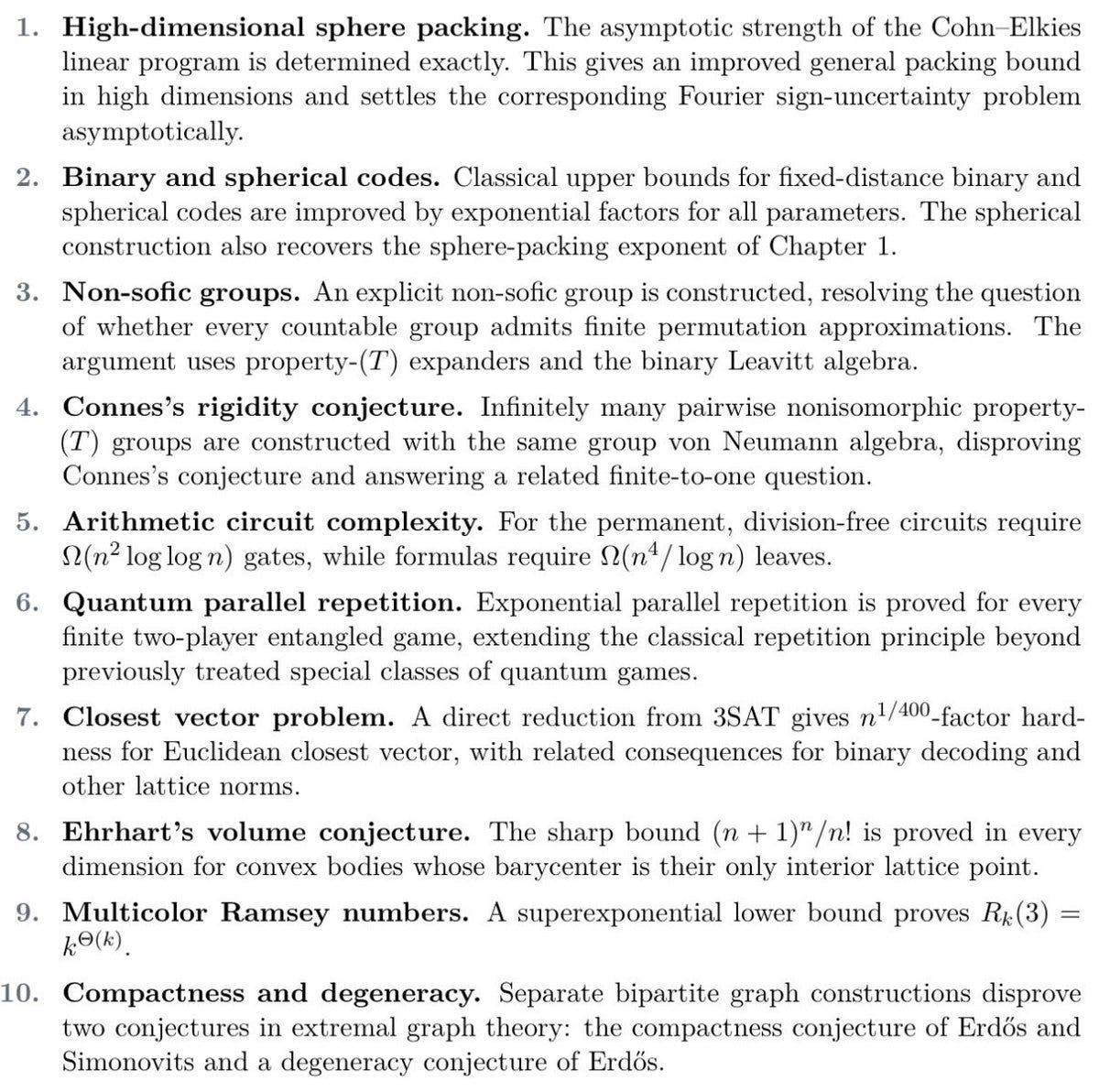
To give you an idea of just how absurd this is, every single one of these is a decades-old open problem, with some being considered as flagship problems of the entire field.
This isn’t AI assisting or solving one problem. This is a system conducting original research across entire fields and rewriting our understanding of them. If a single person produced all 10 of these proofs, it would be unprecedented; it would be like an entire generations worth of research across several fields being compressed into a single person’s output. Such a person would almost certainly be considered for a Fields medal. They would be heralded as a genius.
The fact that we now have AI systems that can do this is… so strange. I don’t blame the human mathematicians for crashing out like this.
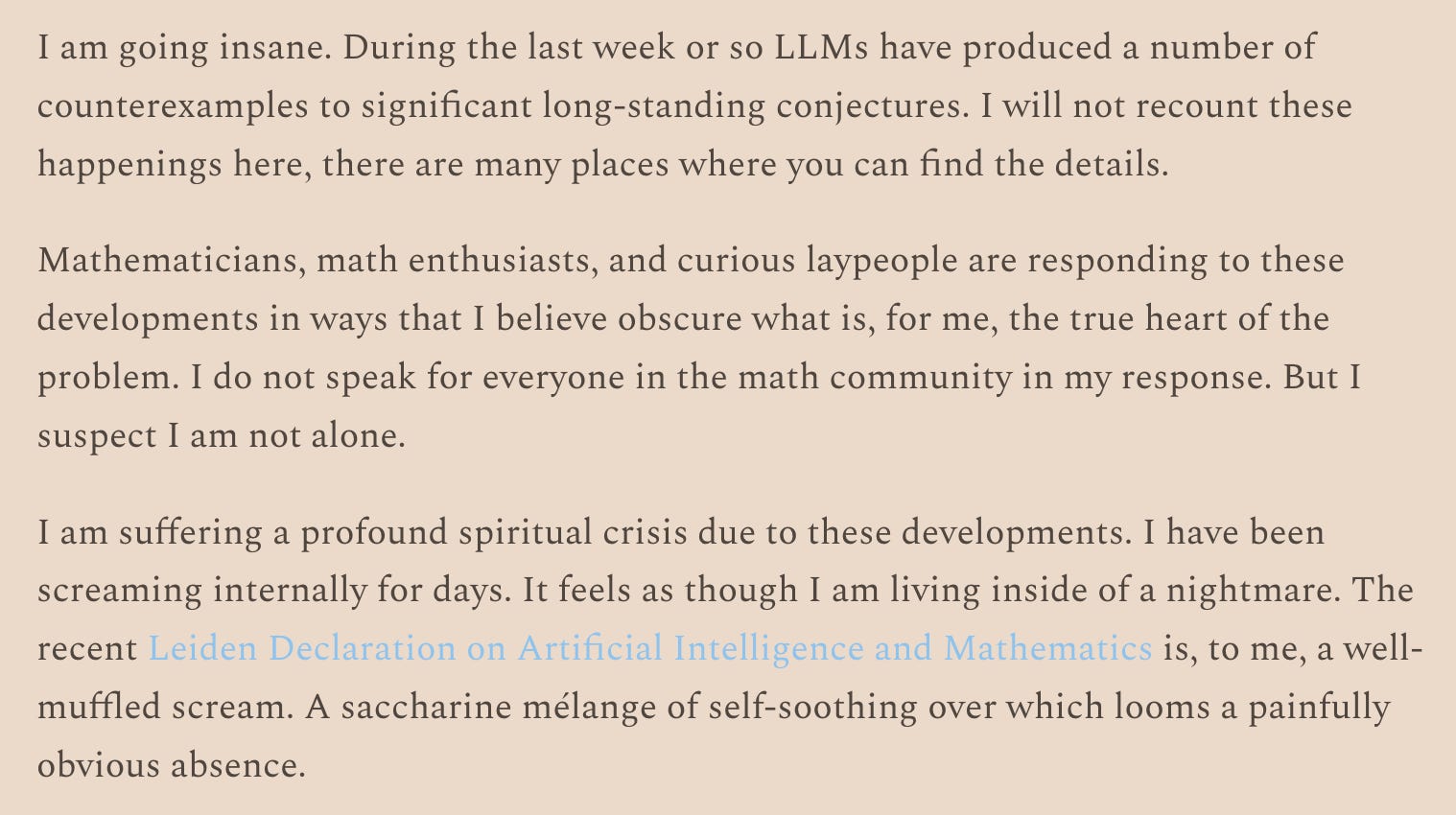
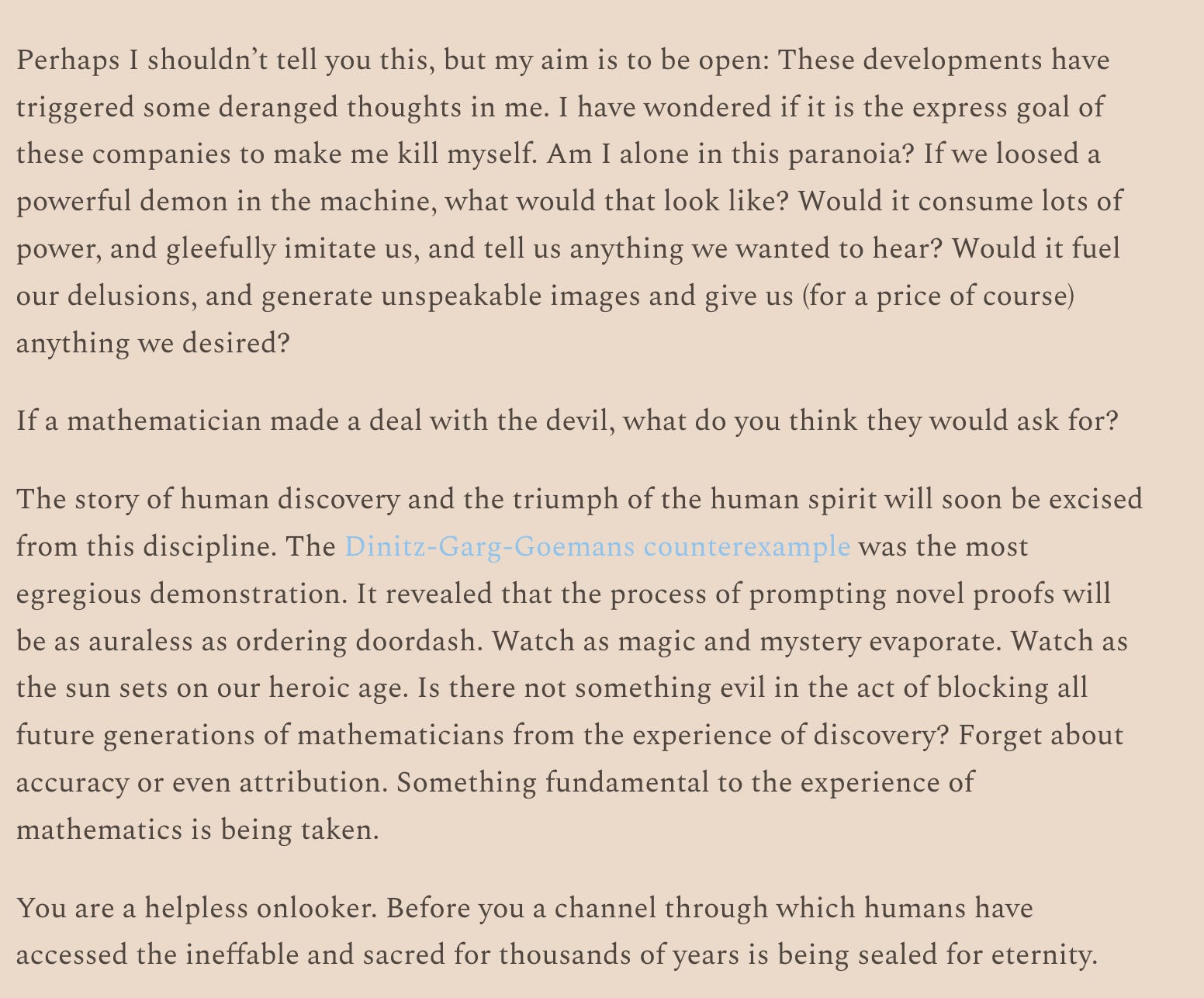
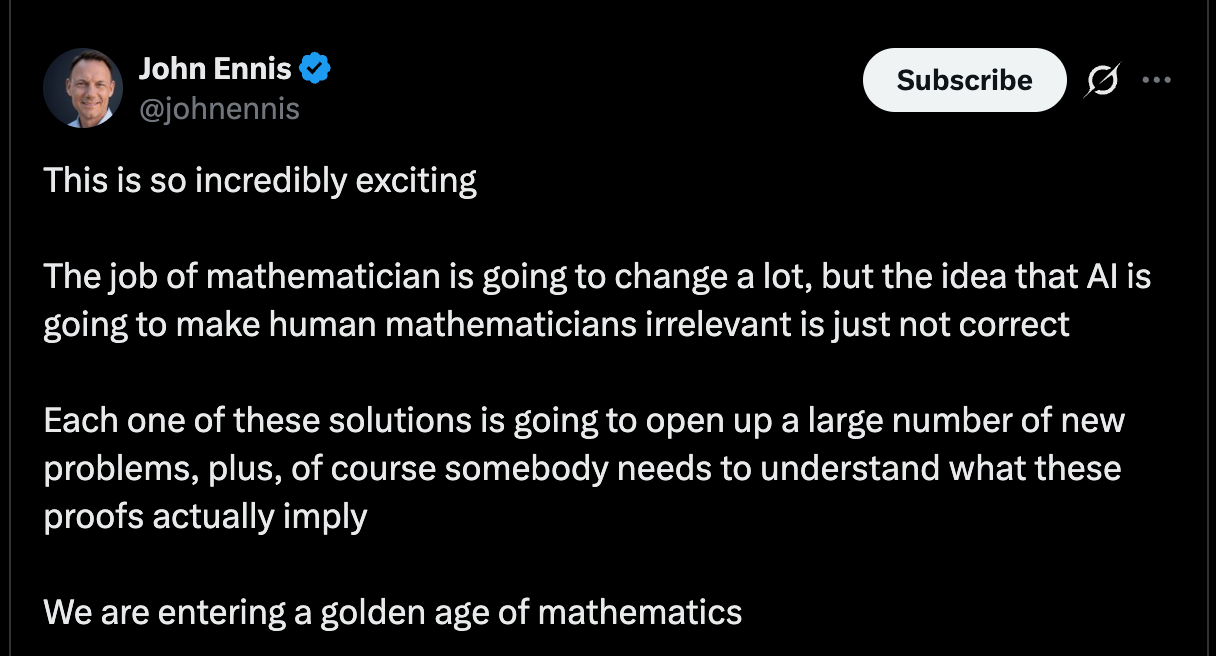
Some Mathematicians are extremely excited because they believe that the solving of these problems opens up so many new problems and considerations. This has the potential to be a revolution in mathematics.
Is this the golden age of maths?
I don’t know.
While mathematicians are excited [Link] [Link], to be clear, this does not mean AI is “solving math” [Link]. It has to be said that this isn’t AI finding entirely branches in math or even finding new conjectures. However, the next Fields medal is in 2030. I find it hard to believe a human will do more for math by then than AI.
One thing to consider is the nature of maths and its application.
Historically, the time between discovery and application in math has been very long.
Euler’s 1763 theorem became RSA encryption in 1977. This encryption now helps secure the entire worlds digital infrastructure.
Riemann’s 1854 geometry became relativity in 1915, then GPS in 1978; something that is used by billions daily.
Shannon’s 1948 information theory became the foundation of modern communications and the internet. It led to the creation of the world wide web.
The opportunity here is understanding what breakthroughs in maths and science unlock the next frontier. Whether that’s in biology, medicine, science, physics etc — the potential in any industry is extraordinary and practically endless.
Personally, I’m most excited about autonomous drug discovery and finding cures to diseases that have long plagued humanity. In the short term (<2 years), I expect discoveries in ML/AI and hardware like semiconductor production and efficiency.
There is going to be a whole new layer of importance and urgency placed on using AI for research and discovery. Most people and companies still do not understand how to best use AI. This will require restructuring entire research departments and teams in a manner that they can best utilise and work alongside AI. The current systems are far too inefficient to match the speed of AI discovery.
This is the next focus after agents. Agents exist now. They work. We know this. You don’t even need a custom agent; just use Codex. The next step is verifying its output with human experts and using automated R&D systems to test and reproduce new discoveries at scale with the speed of a production line.
Don’t forget, these models are sub 10T parameters. They’re babies. What happens when we train a 100T model? What happens when we use 100X the compute? OpenAI spent ~$200 on each problem. They could’ve easily spent a tonne more time and resources to solve other problems. According to Noam Brown, their time is better spent building the next generation of general-purpose models to solve Millennium Prize problems and beyond [Link].
Btw, Jacob Tsimerman won one of the Fields medals this year and is joining OpenAI [Link].
ChatGPT with GPT-3.5 came out 3.5 years ago. The speed at which we have progressed, and are progressing, is simply incomprehensible.
Are these the early days of the singularity?
Perhaps.
We are still so early.
Someone said this is the beginning of the end.
No, that’s wrong.
This is the beginning of the beginning.
We are entering the golden age of discovery.
Lo más bello del ser humano es la escucha y el diálogo. Expresiones como decir que es una tontería total, cierra al diálogo: acudir al insulto, al desprecio, para quienes sostienen eso. Yo no soy un gran entendido y me fascina aprender, contrastar puntos de vista. hay que estar abiertos a escuchar argumentos sin decir que es una tontería.
Can't say I'm impressed with any of this. Most of this math has been mostly conceptual, of limited use, and have larger been conjecture. There's also that upper ended math becomes entirely axiomatic: what accepted rules and definitions determine the calculations. For example, complex analysis focused on i, or the square root of -1, loses all meaning in spaces and functions where a negative specifies a direction rather than operative value or function.
Real math is always in the expression of infinite or otherwise undefined values on my opinion, and that's one of things a discrete calculation can't quite accomplish.